Many business owners still entrust their tax affairs to staff, relatives, or trusted individuals without ensuring whether that person is legally authorized to act as their representative. However, this practice needs to be reconsidered, as the government has issued a new, much stricter regulation. Mistakes in appointing a legal representative can have fatal consequences for your business's compliance status in the eyes of the Directorate General of Taxes (DJP).
Through Minister of Finance Regulation (PMK) Number 44 of 2026 concerning Requirements for Becoming a Tax Representative and Procedures for Exercising Rights and Fulfilling Obligations of Tax Representatives, the government has established clearer requirements regarding who may represent taxpayers. This regulation, promulgated on July 6, 2026, took effect immediately on that date and simultaneously revokes and replaces PMK Number 229/PMK.03/2014, which previously governed similar provisions.
This means that taxpayers who have been relying on other parties to handle reporting, payments, or other tax matters must ensure that the appointed representative has met the established requirements. This is because the validity of the authorization can affect whether tax actions taken on behalf of the taxpayer are legally valid. This is especially crucial for business owners who have just completed the process of establishing a PT (Limited Liability Company), as fulfilling tax administration from the very beginning must be managed legally and precisely in accordance with the latest regulations.
Why Did the Government Update the Tax Representative Rules?
In its considerations, PMK 44/2026 was issued with three main objectives oriented towards legal certainty. First, to align the regulations with Law Number 6 of 2023 concerning Job Creation. Second, to provide legal certainty and equal treatment for parties acting as taxpayer representatives. Third, to perfect the previous regulations, which were deemed not to have comprehensively regulated the requirements for becoming a tax representative.
The previous regulation, PMK Number 229/PMK.03/2014, was considered to still have a number of significant regulatory deficiencies. For example, there was no detailed explanation regarding the competencies that a representative must possess, nor who falls into the category of family or other parties that can be appointed to represent the taxpayer.
Furthermore, along with the increasingly digital tax services through the Taxpayer Portal, the government considered it necessary to have clearer rules regarding who has the right to access tax data and exercise tax rights and obligations on behalf of the taxpayer. This is important to protect the confidentiality of taxpayer data from the risk of leakage or misuse by irresponsible parties.
Who Is Allowed to Become a Tax Representative Under the Latest Regulation?
Unlike the previous regulation, which only permitted Tax Consultants and employees of the Taxpayer, PMK 44/2026 expands the categories of representatives into three main groups transparently:
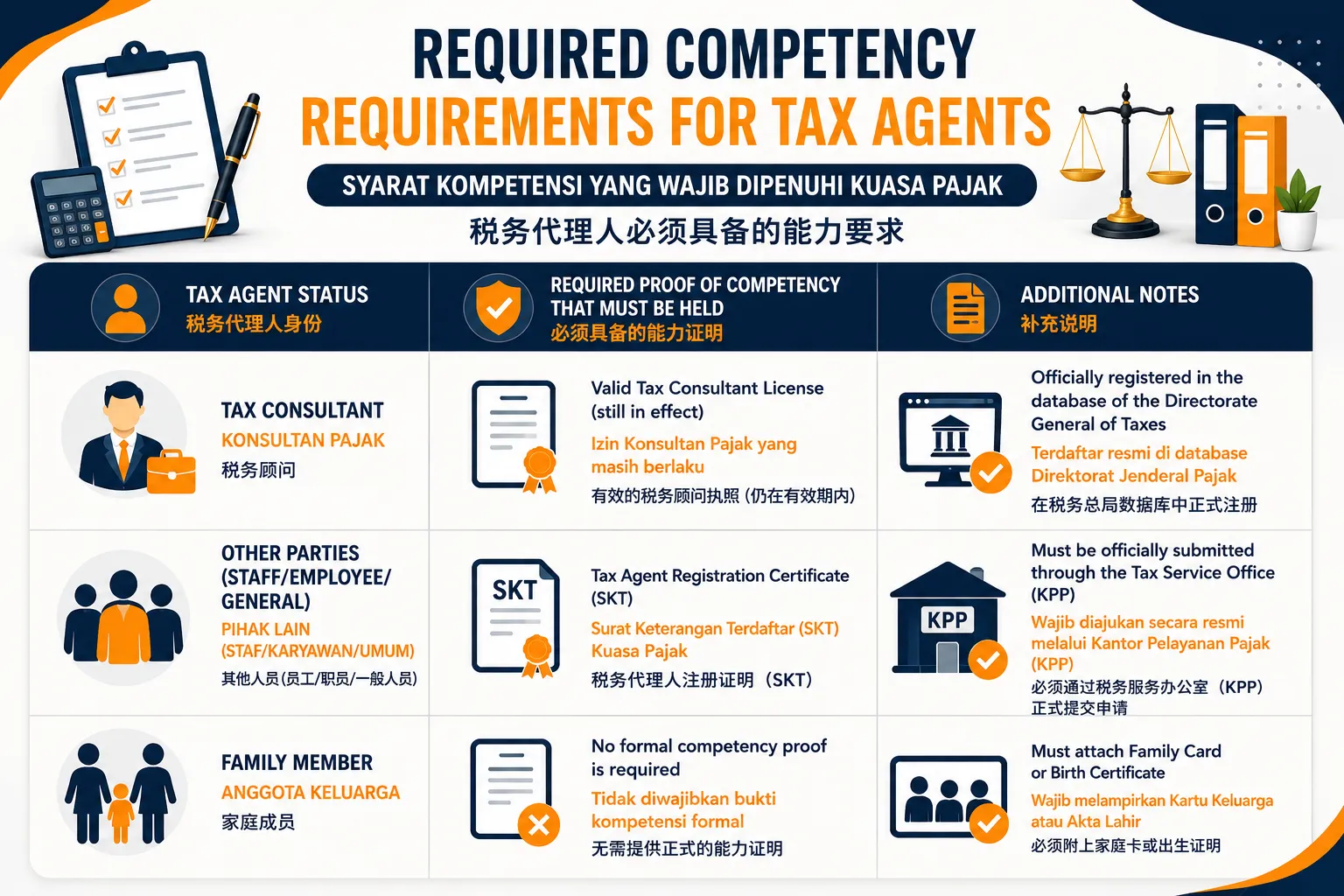
- Tax Consultant: A professional party who holds an official and valid Tax Consultant License.
- Other Parties: Representatives (including internal staff) who have obtained an official Certificate of Registration (SKT) as a tax representative.
- Family Members: Husband, wife, or blood relatives as well as in-laws up to the second degree.
For example, an online shop owner who wishes to have their sibling assist them in filing their Annual Tax Return (SPT) now has a clear legal basis, provided that the family relationship is proven through supporting documents such as a family card. However, it is important to note that even though a legal representative has been appointed, the ultimate responsibility for the execution of tax rights and obligations remains fully with the Taxpayer, and does not transfer to the authorized representative.
Competency Requirements That Must Be Fulfilled by a Tax Representative
Article 3 paragraph (1) of PMK 44/2026 stipulates that every party appointed as a representative, other than family members, is required to possess certain competencies in the form of adequate understanding of tax provisions. This provision is derived from the mandate of Article 51 paragraph (2) of Government Regulation Number 50 of 2022. The proof of such competency is differentiated based on the status of the representative as follows:
Special Rules for Former Employees of the Ministry of Finance
One of the most attention-grabbing provisions in PMK 44/2026 is the strict restriction on former employees of the Ministry of Finance, including retirees of the Directorate General of Taxes (DJP). Based on Article 5 of PMK 44/2026, they cannot immediately practice as tax representatives right after leaving the institution. The applicable provisions include:
- Required to undergo a cooling‑off period of 5 years from the date of retirement, honorable dismissal, or the end of the employment period.
- Must have a good and clean track record during their active service at the relevant institution.
- Must never have been subjected to severe disciplinary punishment related to abuse of authority, gratuities, illegal levies, conflicts of interest, or other ethical violations.
This rule is clearly intended to prevent conflicts of interest (bureaucratic nepotism) while maintaining public trust in the tax representative profession, especially considering that former employees of the Ministry of Finance previously had direct access to strategic data and the state tax system.
Special Power of Attorney: A Legal Document That Must Not Be Made Carelessly
Article 7 of PMK 44/2026 stipulates that a representative must hold a Special Power of Attorney from the Taxpayer, either in electronic form or physical document (paper), before they can act. This official document must contain at least the following minimum components:
- Full name, NPWP, and wet/electronic signature of the Taxpayer granting the power of attorney.
- The specific status of the appointed representative (Tax Consultant, Other Party, or Family).
- The scope of tax rights and/or obligations expressly delegated to the authorized representative.
- The required stamp duty (bea meterai) in accordance with statutory provisions.
If the appointed representative is a family member, supporting documents such as a copy of the family card must be attached. If the power of attorney includes the exercise of rights electronically, the Taxpayer must also grant access approval on the Taxpayer Portal to the representative for digital system validation.
Limits of Tax Representative Authority and Prohibition of Delegation of Authority

This is the part most often overlooked by business owners. It should be noted that one Special Power of Attorney only applies to one authorized representative and is only valid for the specific tax rights or obligations explicitly stated within it.
Pursuant to Article 8 paragraph (3), a representative is explicitly prohibited from delegating their authority to another person. However, the representative may still appoint their employees solely to deliver or receive certain tax documents, using a separate letter of appointment. The appointed party merely acts as a document courier, and does not represent the Taxpayer in substantive tax matters.
When Does the Tax Power of Attorney Terminate?
The granting of tax legal authority is automatically declared terminated if any of the following legal conditions occur in practice:
- The validity period stated in the Special Power of Attorney has expired or the purpose has been fully executed.
- Revoked officially by the Taxpayer through a revocation letter (electronic or paper), where the revocation takes effect from the time it is received by the DJP and does not apply retroactively.
- The Tax Consultant License or SKT of the Other Party is suspended or revoked by the competent authority.
- The representative is convicted of a criminal offense in the tax field or other general criminal offenses.
Once the authority ends, the representative's access to the Taxpayer Portal is automatically terminated by the system. The DJP will send an electronic notification to the Taxpayer and the concerned representative if the termination of authority is caused by license suspension or criminal conviction.
Transition Period for Fulfilling SKT Requirements Until the End of 2026
For parties who do not yet hold an official SKT, PMK 44/2026 provides a sufficient transition period so that business activities are not disrupted. Based on Article 16 paragraph (1), a person who is not a tax consultant may still act as a representative until December 31, 2026, provided they hold a tax brevet certificate or a formal tax education diploma of at least a Diploma III in taxation from an accredited A university.
After this transition period fully ends, all non-family parties who wish to become tax representatives must meet the SKT requirements in accordance with the strict provisions of PMK 44/2026. Therefore, companies are advised to immediately conduct an audit of the legality of their internal tax staff.
Practical Steps for Taxpayers to Avoid Administrative Sanctions
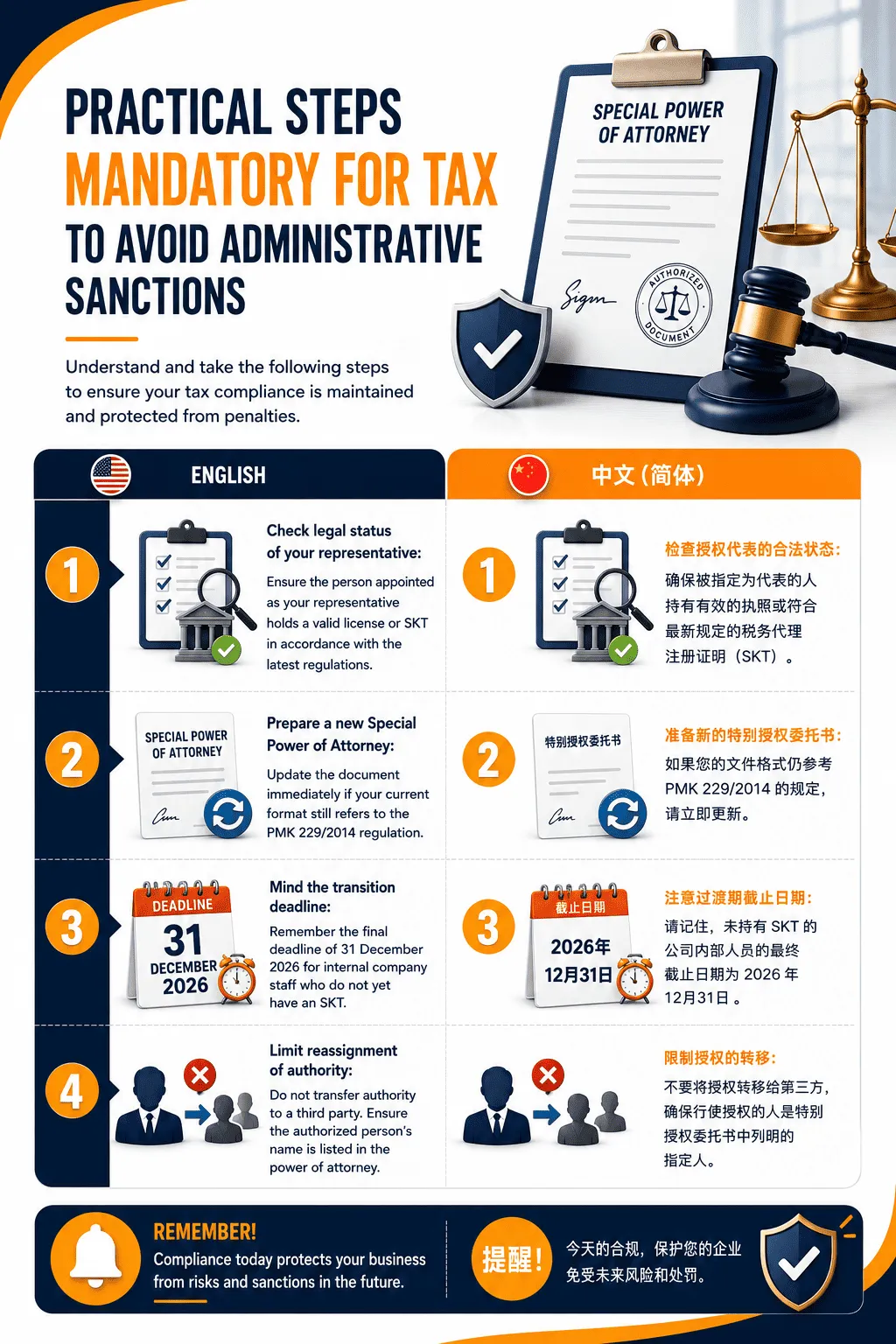
- Check the legal status of the representative: Ensure that the appointed representative holds an official license or a valid SKT (Certificate of Registration) in accordance with the latest provisions.
- Prepare a new Special Power of Attorney: Immediately update the document if your old format still refers to the outdated PMK 229/2014 regulation.
- Pay attention to the transition period deadline: Remember the final deadline of December 31, 2026, for internal company staff who do not yet hold an SKT.
- Limit delegation of authority: Do not allow the representative to delegate authority to a third party; ensure that the person acting is the name listed in the power of attorney.
Conclusion
PMK Number 44 of 2026 brings major changes to the procedures and regulations concerning representatives in the field of taxation in Indonesia. Now, a person appointed as a representative must not only obtain written approval from the taxpayer, but also must legally meet the official competency requirements established by the Ministry of Finance.
This regulation provides administrative flexibility for close family members to act as representatives, while simultaneously tightening the requirements for other parties, including former employees of the Ministry of Finance, in order to maintain the integrity of the system. Therefore, taxpayers need to ensure that the appointed representative has fulfilled all applicable provisions so that every tax action taken on behalf of the taxpayer remains legally valid and avoids legal annulment sanctions.
CONTACT US
Are you considering appointing a tax representative for your business? First, verify the status of the Tax Consultant License or SKT of the prospective representative before signing the Special Power of Attorney, so that all tax reporting and payment processes remain legally valid and free from future dispute risks.
Contact Awan Kusuma Legalitas via WhatsApp for corporate tax compliance consultation, Annual Tax Return (SPT) management, and secure and trusted processing of your business legalities.