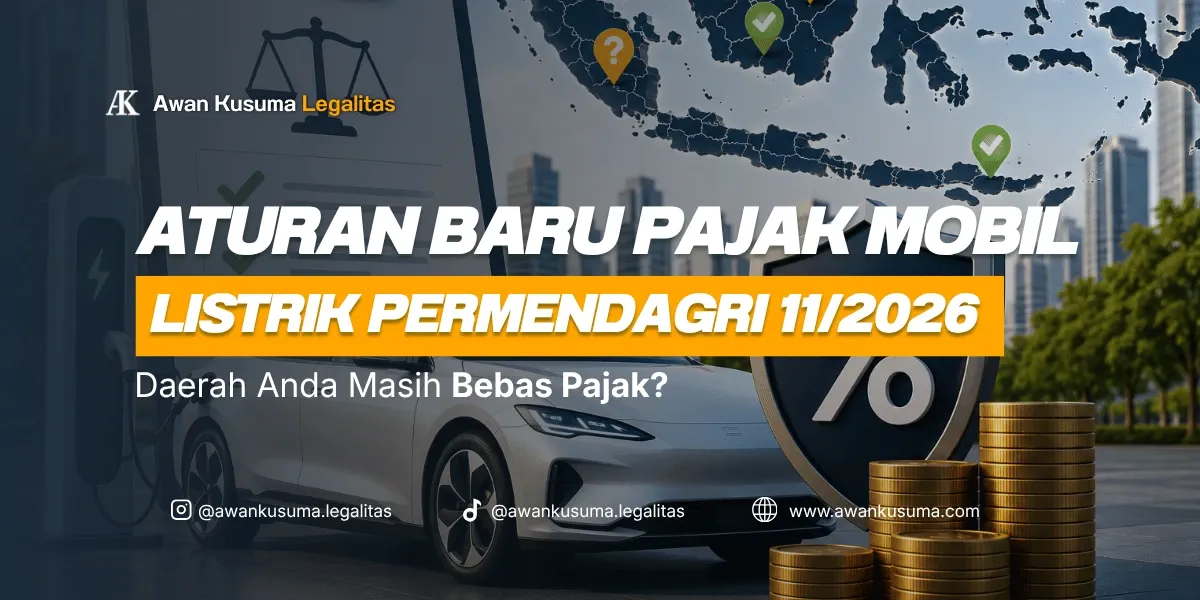
In recent years, the trend of electric vehicle (EV) usage in Indonesia has surged dramatically. One of its main attractions has been the wave of fiscal incentives from the government, which has meant that owners of these futuristic vehicles have barely had to dig into their pockets for tax purposes. Until now, the majority of EV owners were only required to pay the STNK issuance administration fee and the Mandatory Road Traffic Accident Fund Contribution (SWDKLLJ), while the Vehicle Tax (PKB) and Vehicle Transfer Fee (BBNKB) components were cut to zero percent.
However, this policy landscape has now undergone a fundamental shift, sparking heated discussions. The Ministry of Home Affairs has officially enacted Minister of Home Affairs Regulation Number 11 of 2026 concerning the Tax Base for Motor Vehicles, Vehicle Transfer Fees, and Heavy Equipment Tax. This new regulation, effective from April 1, 2026, automatically revokes the old regulation, including Minister of Home Affairs Regulation Number 7 of 2025, which previously served as the basis for national EV tax exemptions.
This move has immediately raised concerns among consumers and industry players. Many have speculated that the golden era of tax-free eco-friendly vehicles has ended. In reality, this new regulation does not completely eliminate incentives but rather changes their distribution mechanism. The exemption of PKB and BBNKB is no longer applied uniformly nationwide but is now fully delegated to the autonomous authority of each regional government.
Legal Basis and Synchronization with the HKPD Law
The issuance of Minister of Home Affairs Regulation Number 11 of 2026 was immediately followed by a tactical move from the central government. The Minister of Home Affairs issued Circular Letter Number 900.1.13.1/3764/SJ instructing all governors in Indonesia to immediately establish regional regulations regarding the provision of incentives or reductions in PKB and BBNKB specifically for electric vehicles.
For vehicle owners, there is no need to panic excessively. In the legal hierarchy, the position of a Ministerial Regulation is below that of a Law. If we refer to Law Number 1 of 2022 concerning Financial Relations between the Central Government and Regional Governments (HKPD Law), the protection for eco-friendly vehicles is actually still very strong.
In Article 7 paragraph (3) letter d and Article 12 paragraph (3) letter d of the HKPD Law, the state explicitly stipulates that motor vehicles that operate using renewable energy are classified as objects excluded from PKB and BBNKB collection. Because laws have higher binding force, these basic provisions in the HKPD Law remain the main legal fortress underlying policy formulation at the regional level.
Article 3 vs. Article 19: The Root of Public Confusion
The polemic and misunderstanding in the public sphere have arisen due to the dualism of technical terms used within the body of Minister of Home Affairs Regulation 11/2026 itself:
- Article 3: Uses the clause that vehicles with renewable energy fuel are excluded from tax objects.
- Article 19: Places Battery-Based Electric Motor Vehicles (KBL) as subjects that receive incentives in the form of exemptions or reductions by regional heads.
This difference in wording has triggered a misinterpretation, as if electric vehicles have been changed to full tax objects that could at any time be subject to normal charges. In fact, Article 19 was not created to cancel the exclusion status, but rather as an administrative corridor for regional governments to design their own incentive schemes independently. The direct impact is that the uniformity of tax-free facilities has disappeared, replaced by policies that may differ from one province to another.
Mechanism and Simulation of How to Calculate Electric Vehicle Tax
Based on the provisions in Article 14 of Minister of Home Affairs Regulation 11/2026, the calculation of the Tax Base (DP) for vehicles is determined through a precise mathematical formula. The main variables come from:
Tax Base (DP) = NJKB × Coefficient Weight
- NJKB (Motor Vehicle Sales Value): The general market price officially released by the brand holder agent and set nationally by the government.
- Coefficient Weight: A multiplier index number that reflects the level of road damage or pollution caused by the vehicle's operation.
As a concrete simulation example, let's calculate a rough estimate for a popular electric car unit, the BYD Atto 3. Suppose the determined NJKB value is IDR 229,000,000 with a passenger car coefficient weight index of 1.05. Then, the Tax Base value is:
DP = IDR 229,000,000 × 1.05 = IDR 240,450,000
If a regional government decides not to provide any incentives at all and applies the normal PKB rate of 2%, then the annual tax burden that the owner must pay reaches:
Annual PKB = 2% × IDR 240,450,000 = IDR 4,809,000
This value is certainly a very significant cost jump compared to the previous regulation, where owners only had to pay the SWDKLLJ component without millions of rupiah in PKB.
Map of Incentive Policies in Various Regions
The flexibility provided by Article 19 paragraphs (1) to (3) of Minister of Home Affairs Regulation 11/2026 has caused the direction of incentive policies to now diverge. This relief space applies broadly, covering factory-built pure electric vehicles, vehicles converted from fossil fuels, and even electric vehicle units produced before 2026.
How is the current response map of regional governments?
- DKI Jakarta: Still choosing to maintain consumer convenience by continuing to apply full tax exemptions referring to Regional Regulation Number 38 of 2023, while aligning new derivative regulation drafts.
Impact on Consumers and the EV Industry Ecosystem
This regulatory climate change is occurring amidst the flourishing performance of the electric vehicle industry. Data from the Indonesian Motor Vehicle Industry Association (Gaikindo) recorded that battery-based electric vehicle (BEV) sales in the first quarter of 2026 successfully reached 33,150 units, skyrocketing by 95.9% compared to the same period the previous year, which was held at 16,926 units.
This massive growth rate could potentially be hampered if regional governments rush to eliminate their fiscal incentives. The increase in total cost of ownership due to annual tax burdens is predicted to make consumers think twice about switching from conventional vehicles. For business actors providing fleet transportation services, this situation demands careful recalculation of the company's operational budget.
Practical Steps for Electric Vehicle Owners and Prospective Buyers
To avoid being trapped in incorrect cost estimates, take the following four anticipatory steps:
- Conduct Regional Validation: Contact the local Regional Revenue Agency (Bapenda) or Samsat office where your vehicle is registered to obtain certainty about local incentive amounts.
- Check NJKB Documents: Review the vehicle invoice to find out the actual NJKB value as a basis for independent calculation.
- Confirm Old Units: For owners of pre-2026 vehicles, ensure that the local regional regulation still protects your incentive rights regardless of production year.
- Ignore Social Media Rumors: Avoid using tax simulations that go viral on social media as absolute references, as their legal validity cannot be accounted for.
FAQ: Popular Questions About Minister of Home Affairs Regulation 11/2026
Are all electric vehicles automatically subject to full tax starting April 2026?
Not automatically. This regulation only shifts authority. Your electric vehicle will only be subject to full tax if the provincial government where you are domiciled issues a specific regional regulation that revokes local incentives.
Why is there different treatment between one region and another?
Because Minister of Home Affairs Regulation 11/2026 gives full autonomous rights to regional heads to determine the amount of tax reduction based on the financial conditions and green infrastructure readiness of their respective regions.
What is the legal status of the HKPD Law in this case?
The HKPD Law still holds the highest legal position that prohibits the imposition of taxes on renewable energy vehicles. However, its technical operational implementation in the field must follow the derivative regulations issued by the Ministry of Home Affairs and the Provincial Government.
Protect Your Business Assets and Operational Legality
The shift in tax regulations in Minister of Home Affairs Regulation Number 11/2026 is a strong signal that regulatory dynamics in Indonesia move very quickly. For business actors with high commitment to green logistics operations, this regional regulatory uncertainty must be mitigated with legally compliant legality governance and corporate administration.
For companies managing dozens of electric vehicle fleets for commercial needs, ensure your operational validity is protected through comprehensive business licensing through integrated NIB and OSS management services. A strong licensing foundation will make it easier for your company to claim the fiscal facility rights provided by the state.
Furthermore, if uncertainty in regional tax rates begins to affect financial burden projections or triggers administrative disputes with regional agencies, our advocate team is ready to assist you through our trusted business legal consultant services. We ensure that every investment decision and fleet operational activity of your company runs in accordance with the latest legislation corridors, free from the risk of detrimental sanctions and fines.