
Indonesia continues to strengthen its economic competitiveness on the global stage through the latest regulatory breakthroughs. One of the most strategic steps that now officially has a legal framework is the establishment of the Indonesia International Financial Center (PFII).
For business actors, investors, and legal practitioners, the emergence of this financial hub brings fresh air and a new chapter in the governance of the national financial market. So, what exactly is PFII, why is its establishment specifically regulated by law, and how does it impact the business ecosystem in the country? Let's take a look at the following comprehensive review.
Understanding the Basic Concept of PFII
PFII, or the Indonesia International Financial Center, is a special zone designed by the government to build a globally standardized ecosystem for financial transactions and services. Through this zone, Indonesia positions itself to be able to compete directly with leading regional financial centers.
The presence of PFII is tasked with attracting foreign direct investment, facilitating large-scale portfolio instrument transactions, and expanding long-term financing access for strategic projects in Indonesia.
Why Did the Government Establish PFII?
The establishment of PFII is based on the urgent need to deepen the domestic financial market. So far, most cross-border transactions and long-term financing flows still rely heavily on foreign financial institutions.
By presenting an international financial hub domestically, the government targets several key achievements:
- Increasing Foreign Capital Inflow: Making Indonesia a prime destination for global asset management and international financing institutions.
- Diversifying Development Sources: Reducing dependence on the state budget by channeling international private investment funds into various industrial sectors.
- Integrated Licensing and Ease of Doing Business: Providing integrated licensing efficiency at the national level, including synchronization of industrial licensing systems through SIINAS and NIB management for business actors.
The Three Main Pillars Driving PFII
Based on the official explanation from the Ministry of Finance, the operational success of PFII is supported by three main pillars:
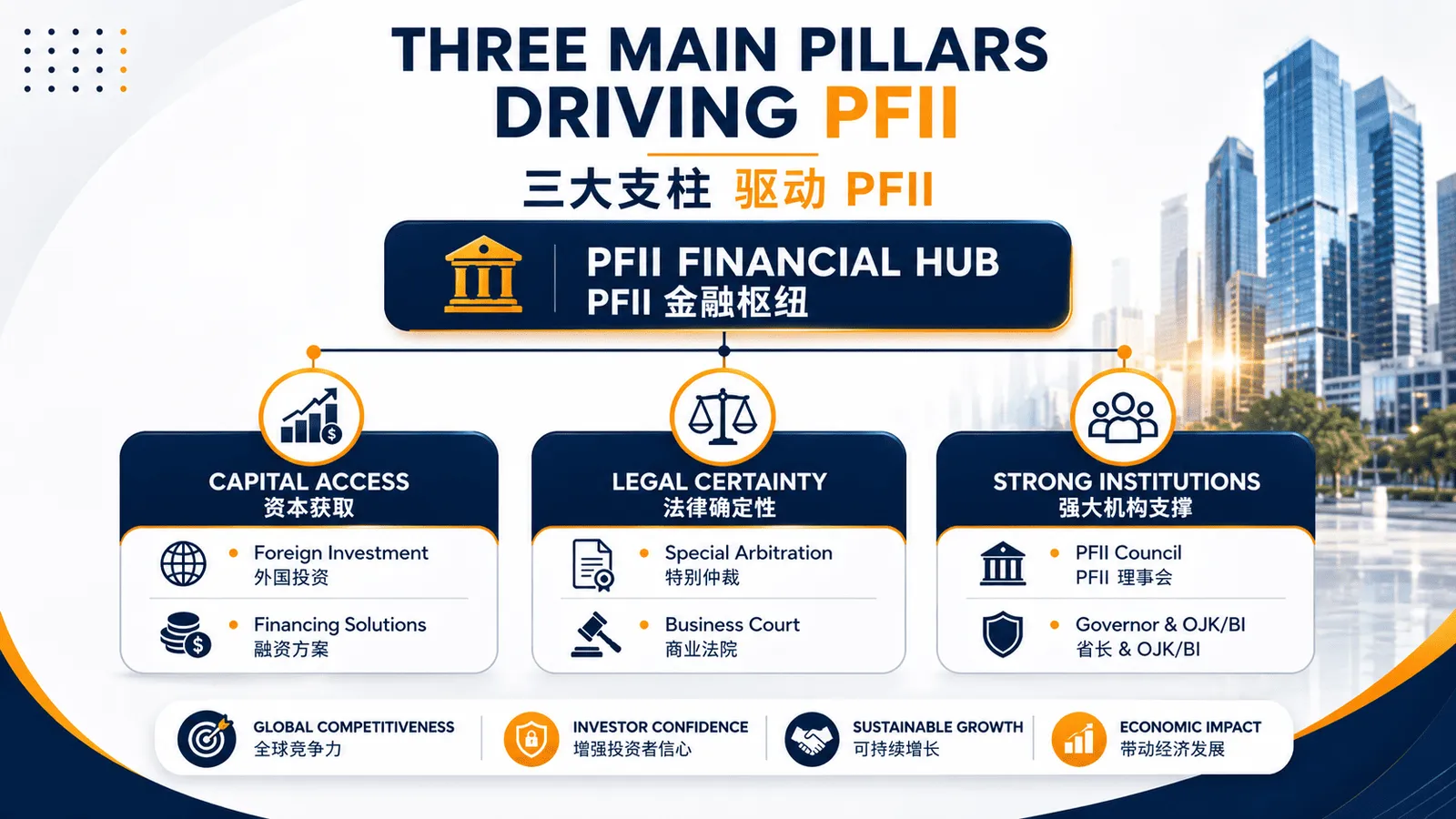
1. Access to Capital and Investment
PFII is designed to be a platform that facilitates the entry of equity and long-term loan funds. This ease of capital flow provides certainty for large-scale business entities that intend to strengthen their corporate structure, even when they have to make adjustments such as Buying and Selling Company Shares or expanding subsidiaries in Indonesia.
2. Legal Certainty and Asset Protection
Global investors require asset protection guarantees and efficient legal certainty. In addition to being supported by special business court mechanisms, financial and technology entities entering the zone can also legally secure their innovations and intellectual property through Patent registration and Trademark protection.
3. Strong Special Institutional Framework
The governance of this zone is handled by a separate institutional structure. Supervision is carried out in an integrated manner by the PFII Council, which works in synergy with Bank Indonesia (BI), the Financial Services Authority (OJK), and the Deposit Insurance Corporation (LPS).
Who Leads and Manages PFII?
Operationally, PFII will be led by a PFII Governor who is directly appointed by the President. In carrying out management functions, the governor is assisted by cross-ministry and relevant institutions, including the Ministry of Law, academics, and financial industry practitioners.
This collaboration ensures that all regulations issued within the zone remain relevant to global market needs without neglecting the stability of the national financial system.
Why Does It Require a Special Law?
The presence of PFII is not a policy that emerged suddenly. Its establishment is an explicit mandate of Law Number 4 of 2026 concerning Amendments to Law Number 4 of 2023 on the Strengthening and Development of the Financial Sector (P2SK).
The ratification of the PFII Bill into official law was determined at the Plenary Session of the Indonesian House of Representatives on July 21, 2026. This strong legal basis provides legitimacy guarantees, including the provision of special incentives for business actors within the zone.
Special Facilities and Regulations in the PFII Law
One of the main attractions of the PFII Law is the availability of various facility conveniences and licensing for business entities operating within it, including:
- Tax and Customs Facilities: Provision of special fiscal incentives for certain financial transactions to support the flow of international financial goods and services.
- Special Operational Standards: Ease of representative license registration to zone operational quality standardization that can be aligned with certification fulfillment such as SNI for the service sector and its supporters.
FAQ: Popular Questions About PFII
What does PFII stand for?
PFII stands for Pusat Finansial Internasional Indonesia (Indonesia International Financial Center).
Does PFII replace the role of OJK or Bank Indonesia?
No. PFII is built to complement and strengthen the existing financial market ecosystem. Macro and microprudential supervision still involves BI and OJK in an integrated manner.
Can local business actors utilize PFII facilities?
Yes. As long as the business entity meets the criteria requirements for business activities regulated in the implementing provisions of the PFII Law.
Is PFII fully operational at this time?
Although the PFII Law has been enacted as the main legal framework, technical operational implementation in the field is still awaiting the gradual issuance of government regulations and derivative implementing rules.
Prepare Your Business Legitimacy Facing the New Financial Era
The government's step to present the Indonesia International Financial Center sends a strong signal that the national investment climate will become increasingly competitive and wide open. Understanding the direction of regulatory changes from the start is the key for your business to seize opportunities faster than competitors.
Is your company ready to undertake business legality arrangements, legal entity establishment, or amendments to the company's articles of association? The Awan Kusuma Legalitas consultant team is ready to assist with all your business licensing needs, from business entity establishment, IPR legality, to managing Company Business Activity Changes to align with the latest industry growth direction.
Want to consult about business licensing legality and company legal entity establishment? Contact Us via WhatsApp now to connect with the Awan Kusuma Consultant Team!