Choosing the right business entity or legal form is the most crucial first step when you decide to take a business seriously. Many business owners rush to establish their legal entity without understanding the differences in functions, legal liability limits, and tax consequences behind each chosen entity.
As a result, problems arise along the way. From confusion over dividing share portions, the risk of personal assets being dragged in when the business suffers losses, to obstacles when applying for PKP (Taxable Entrepreneur) status to attract large-scale projects.
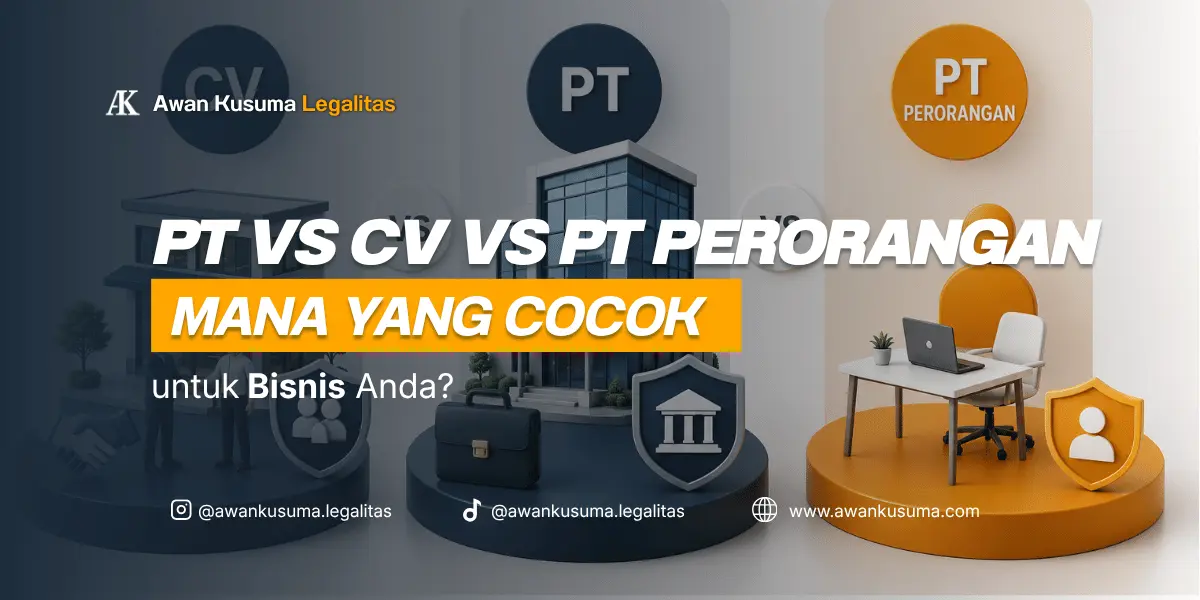
To ensure you don't take the wrong step, let's thoroughly dissect the differences between a Regular PT (Limited Liability Company), CV (Limited Partnership), and Sole Proprietorship PT, complete with a tactical quiz to help your business decision.
Understanding the Three Main Business Entities in Indonesia
Before comparing their features, let's understand the basic characteristics of each business entity:
1. CV (Commanditaire Vennootschap / Limited Partnership)
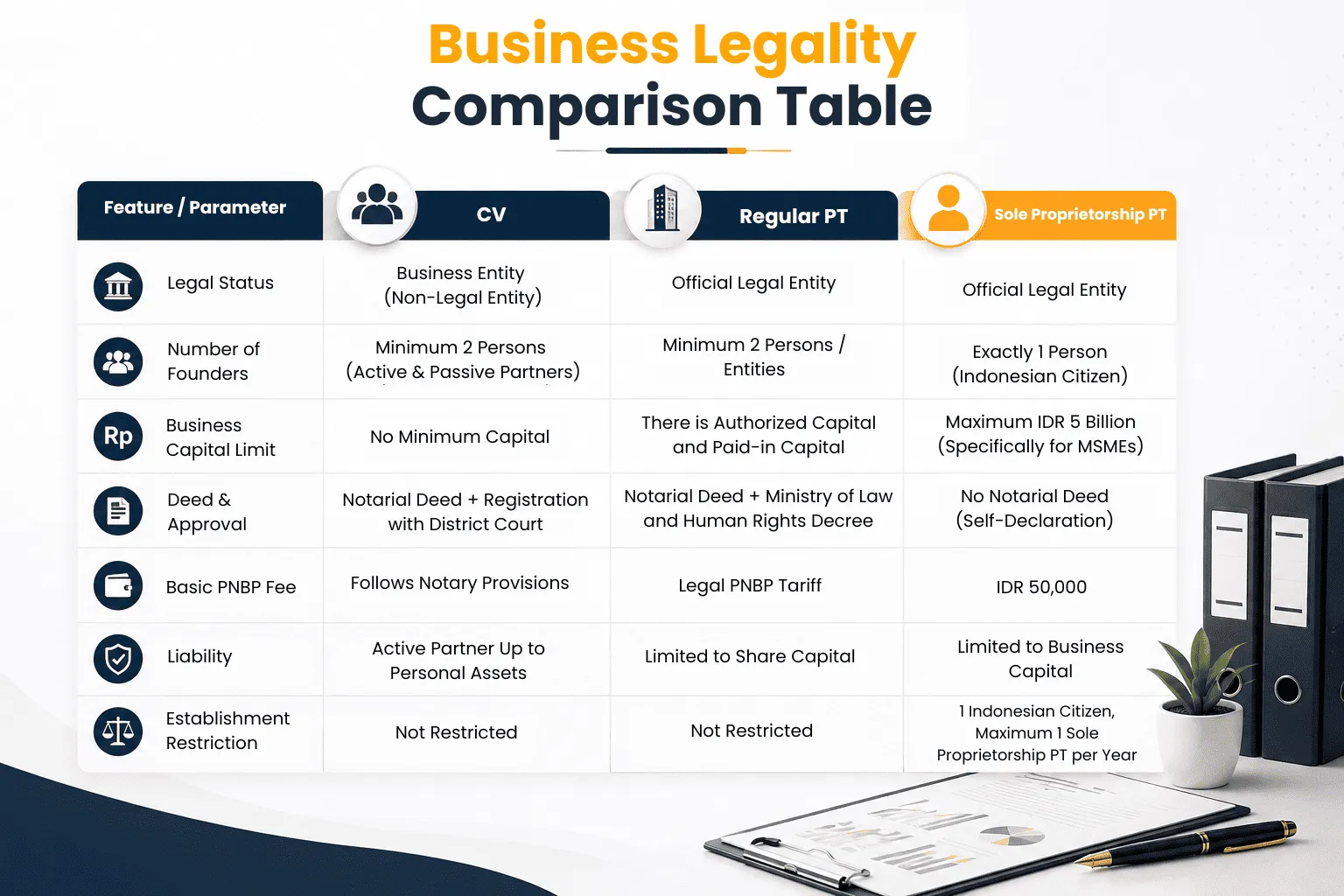
A CV is a capital partnership established by two or more persons, divided into active partners (managers) and passive partners (investors). The establishment of a CV has no minimum capital requirement. The formation process is done through a notarial deed, which is then registered with the Ministry of Law through the Business Entity Administration System, and recorded with the local district court. The main characteristic of a CV is the unlimited liability of the active partner, meaning the active partner's personal assets can be seized if the business suffers losses or incurs debts.
2. Regular PT (Limited Liability Company)
A PT is an official legal entity established by at least two persons or entities with ownership in the form of shares. The basic capital requirement for establishing a PT is generally set at a minimum of 25% (although the amount of paid-in capital can be adjusted according to the founders' agreement in the deed). The main advantage of a PT lies in the strict separation of assets. The liability of owners or shareholders is limited, only to the value of the shares contributed to the company.
3. Sole Proprietorship PT (Individual Limited Liability Company)
A Sole Proprietorship PT is a legal entity innovation specifically designed to provide a protective vehicle for Micro and Small Enterprises (UMK) with a maximum business capital of IDR 5 billion. This entity can be established by just 1 Indonesian citizen who acts simultaneously as shareholder and director. The registration process is very practical because it does not require a notarial deed; you simply fill out a self-declaration statement with a very affordable PNBP fee of IDR 50,000. It is important to note that by regulation, 1 Indonesian citizen is only allowed to establish 1 Sole Proprietorship PT within a period of 1 year.
Business Legality Comparison Table
The following concise table makes it easy for you to see the key differences between the three entities:
Tactical Quiz: Which Business Entity Suits You Best?
Still unsure which to choose? Answer these 3 simple questions to find the business form that best matches your current business situation:
Question 1: How many founders or capital owners does your business have?
- A. Just myself (1 person).
- B. There are 2 or more people (business partners/capital partners).
Question 2: What is your attitude toward personal asset risk?
- A. I want my personal assets to be safe and completely separate from company assets.
- B. It doesn't matter if they're combined; what's important is that the initial business setup is fast and efficient.
Question 3: Who is your target market and what is your initial capital scale?
- A. Capital under IDR 5 billion, focusing on starting an independent micro/small business.
- B. Flexible capital, targeting the local market, wanting to participate in general service procurement.
- C. Targeting large corporations, needing ideal share separation, ready to grow rapidly.
💡 Your Quiz Recommendation Results:
- Mostly A answers (Independent & Protected):
Your best choice is Sole Proprietorship PT. You get official legal entity status that separates personal assets without needing to bring in other partners. If your business capital is ready, you can immediately processSole Proprietorship PT Establishment practically. - Mostly B answers (Local Partnership / Services):
The most suitable business form is CV. It is ideal for those running a business with partners without the complexity of complicated share divisions. Start arranging your partnership legality with the right CV Establishment services. - Mostly C answers (Large Scale & Corporate):
The absolute option for you is to establish a Regular PT. This form provides the highest level of trust in the eyes of investors, banks, and large clients. Immediately secure your business legal structure through professional PT Establishment services.
FAQ: Popular Questions About Business Entities
Can a Sole Proprietorship PT be converted into a Regular PT if the business grows?
Yes. If the turnover or business capital of your Sole Proprietorship PT exceeds the IDR 5 billion limit, or you wish to bring in new shareholders, the Sole Proprietorship PT status must be changed to a Regular PT through a notarial deed.
Can a Virtual Office address be used for PT or CV registration?
Absolutely. As long as the virtual address is located in a valid commercial zone, you can use it as the company's legal domicile. You can combine your entity establishment with trusted Virtual Office services.
Are all three business forms required to report monthly and annual tax obligations?
Yes. All business entities that have obtained an NIB and corporate NPWP are required to maintain cash records and report their tax obligations in an orderly manner.
Secure Your Business Legality with the Experts
Each business entity form has its own advantages and purposes. Making the right legality decision from the start will save your business from legal risks and cost inefficiencies in the future.
Still unsure which choice is the best fit, or need assistance with business cash reporting? The Awan Kusuma legal and tax consultant team is ready to provide comprehensive consultation. We are also ready to assist with your periodic business report compliance through Annual SPT services so that your business continues to grow safely and sustainably.
Want a free consultation to choose and arrange the most suitable business entity? Contact Us via WhatsApp now to connect with the Awan Kusuma Consultant Team!