The issue of business legality and tax obligations has always been a hot topic that sparks debate among micro, small, and medium enterprise (MSME) owners. Many business owners hesitate or deliberately delay obtaining a Business Identification Number (NIB) because they are haunted by one fear: once our business data enters the digital licensing system, will tax officers immediately come after us?
This concern has grown stronger as the integration of the licensing system with national tax governance intensifies. However, before you make a decision that could harm your business development, it is important to clarify the actual legal facts.
Having basic legality does not automatically make your business subject to taxes. There are clear limits and regulations that separate business legality status from the emergence of tax payment obligations.
NIB Is Not NPWP: Two Identities with Different Functions
The most common misconception in the field is treating business identity and tax identity as the same thing. In fact, functionally they play completely different roles:
- NIB (Business Identification Number): Serves as the official business legality identity issued through the Online Single Submission (OSS) platform. You can manage this document independently or utilize NIB and OSS management services to ensure all Indonesian Standard Industrial Classification (KBLI) codes are registered precisely.
- NPWP (Taxpayer Identification Number): Serves as a tool in tax administration that affirms the rights and obligations of taxpayer registration at the Directorate General of Taxes (DJP).
Although data integration between institutions is now tighter, having a basic license focuses on fulfilling business legality, while tax collection is purely based on the amount of income and your tax status.
Why Is the Issue of "Having an NIB = Getting Taxed" Rising Again?
Public attention to this issue has re-strengthened due to the massive integration steps between the OSS system belonging to the Ministry of Investment/BKPM and the DJP Coretax system. Many business owners worry that the data they input when registering a license will be immediately used for unilateral tax assessment.
Responding to this assumption, Maman Abdurrahman, the Minister of MSMEs, emphasized that obtaining a Business Identification Number (NIB) is not related to tax collection. In a report by ANTARA on June 9, 2026, he explained that NIB is a business legal identity, while tax obligations still follow applicable tax provisions. Thus, having an NIB does not automatically make business actors required to pay taxes.
Legal Basis: Distinguishing PP 28/2025 and PP 20/2026
The separation between legality obligations and fiscal obligations is regulated by two fundamentally separate legal frameworks:
1. PP No. 28 of 2025 (Business Licensing Regulation)
This Government Regulation serves as the foundation for Risk-Based Business Licensing through OSS. The main function of issuing licenses under this regulation is as a business registration mark, proof of commitment fulfillment, and a basic distribution permit for business operational activities.
2. PP No. 20 of 2026 (Income Tax Regulation)
On the other hand, income tax (PPh) payment obligations are specifically regulated through PP No. 20 of 2026. This regulation clarifies the criteria for recipients of the 0.5% Final PPh facility, which is now focused on Individual Taxpayers, Cooperatives, and Sole Proprietorship PTs that meet certain turnover thresholds.
The emergence of tax payment obligations is determined by rational factors such as business entity type, annual turnover amount, and taxable income criteria, as stipulated in Articles 56 to 58 of PP 20/2026. Having a business license is not at all the sole trigger for tax collection.
Who Is Actually Required to Pay Taxes After Having an NIB?
The obligation to report and pay taxes will only bind your business if it has met the following objective and subjective tax requirements:
- The business is actively operating and generating income (turnover).
- The annual gross income has exceeded the PTKP (Non-Taxable Income) threshold for Individual Taxpayers, or exceeded the IDR 500 million per year turnover threshold for individual MSMEs.
- The business is established in the form of a Legal Entity or official Business Entity, such as a PT or CV. If you are planning to expand your business to a partnership scale, you can organize its legality throughCV establishment services from the start.
For example, a small trader who obtains a license to apply for People's Business Credit (KUR) will not suddenly be billed for taxes if their turnover is still below the PTKP threshold. Conversely, once an entity is established and obtains a license, tax obligations arise from the status of that legal entity, not from the documents they hold.
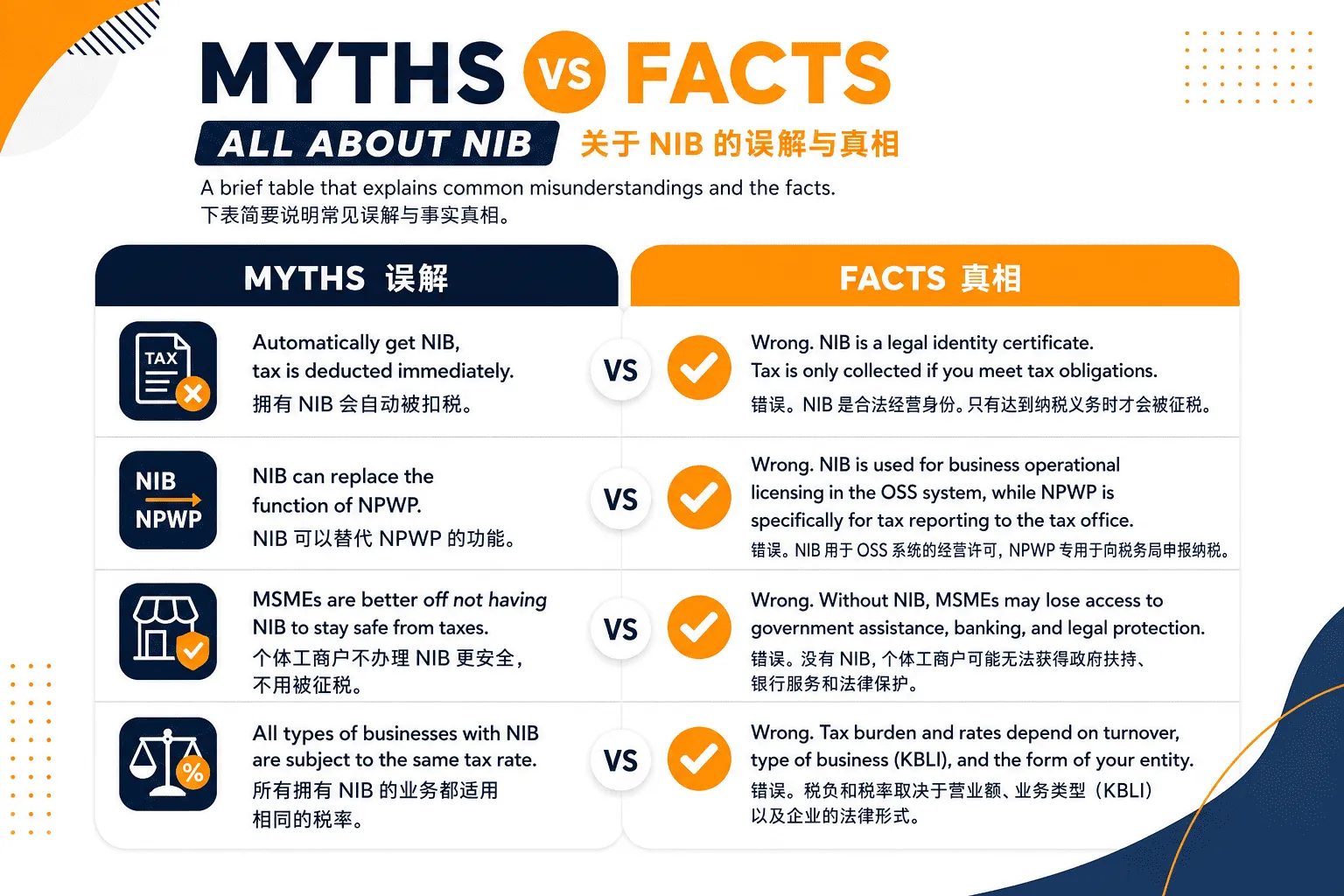
Myths vs Facts About NIB
The following concise table clarifies various common misunderstandings circulating in the community:
Real Benefits of Having an NIB for Business Actors
Rather than avoiding license registration due to unfounded fear, promptly arranging legality actually brings positive impacts for your business leap:
- Guaranteed Legality: Your business is officially registered and avoids administrative sanctions in the operational area.
- Ease of Banking Access: NIB is a primary requirement for opening a company bank account and applying for business credit (such as KUR).
- Wider Market Opportunities: Facilitates partnerships with large-scale private companies and government procurement of goods and services. Even to enter large projects, your entity status can be upgraded to an official entrepreneur through PKP (Taxable Entrepreneur) status processing.
Wise Steps After Your NIB Is Issued
- Understand Your Business Tax Status: Carefully assess whether your business is classified as an individual business or a legal entity.
- Maintain Orderly Turnover Bookkeeping: Disciplined recording of monthly cash flow and gross income to know when your business starts reaching the taxpayer threshold.
- Choose the Appropriate Business Form: Select an efficient legal entity so that your capital structure and personal asset separation are well protected.
FAQ: Popular Questions About NIB and Taxes
Will a newly registered micro MSME be immediately contacted by tax officers?
No. The government has emphasized that issuing NIB for MSMEs is intended for business data collection and development, not for spontaneous tax collection actions.
What if my business turnover is still below IDR 500 million per year?
Under applicable individual MSME tax regulations, turnover up to IDR 500 million in a tax year is not subject to the 0.5% Final PPh (tax-free).
Is there a fee for obtaining an NIB?
The process of obtaining an NIB through the official government OSS platform is free of charge (no fee).
Arrange Your Business Legality and Tax Obligations with Experts
Running a business with valid legality is the best foundation to grow without anxiety. Don't let misinformation hinder your business potential to level up and expand market reach.
For MSME owners who want to secure their business identity with a flexible and efficient legal structure, our team is ready to assist with Sole Proprietorship PT Establishment quickly and officially. With the right entity establishment, your business has clear asset separation and much more organized tax governance.
Additionally, if you need certainty regarding business cash reporting and tax compliance after the license is issued, the Awan Kusuma consultant team also provides preciseAnnual SPT assistance services. We ensure all your business tax rights and obligations are fulfilled efficiently in accordance with applicable laws.
Want to take care of business legality and tax consultation without the hassle? Contact Us via WhatsApp now to get trusted legal assistance from the Awan Kusuma Team!