For online store owners who depend on digital platforms for their business turnover, get ready for a new chapter in business governance in Indonesia. Starting August 1, 2026, the Directorate General of Taxes (DJP) will officially implement an automatic Income Tax (PPh) withholding mechanism on major e-commerce platforms.
Many online sellers are still delaying compliance with this new regulation, even though the transition and socialization period began in early July 2026. Director General of Taxes Bimo Wijayanto explained in a press conference, "The appointment of the first and main marketplace, the initial policy that we will convey, will take effect starting August 1; there is still one month of preparation," Bimo said as quoted from CNBC Indonesia.
The government itself emphasizes that this step is not to burden business actors with new types of taxes, but purely a shift in state administrative oversight methods. Bimo himself stated, "There is no new tax. What changes is only the administrative mechanism. Previously, sellers paid independently; now it is collected by the marketplace," as quoted from Kompas.id. Although it is only a change in mechanism, it still directly affects the amount of cash received by sellers daily, so the time to prepare bookkeeping, cash flow, and pricing strategies is very short.
Legal Basis of PMK Number 37 of 2025 and Affected Parties
The main legal foundation for this massive policy is Minister of Finance Regulation (PMK) Number 37 of 2025 concerning the Appointment of Other Parties as Income Tax Collectors and Procedures for Collection, Deposit, and Reporting of Income Tax on Income from Trading Through Electronic Systems.
Regarding the authority to appoint platforms, Director General of Taxes Bimo Wijayanto explained, "This appointment is made by the Director General of Taxes based on the delegation of authority from the Minister of Finance," as quoted from CNN Indonesia. He added that the four designated marketplaces—Tokopedia, Shopee, Lazada, and Blibli—were selected due to their technological readiness, large transaction volumes, use of escrow accounts, and ability to fulfill state tax obligations.
It must be emphasized that PMK Number 37 of 2025 does not change the existing tax rates at all. For micro, small, and medium enterprises (MSMEs), the final PPh rate of 0.5% still refers to Government Regulation (PP) Number 55 of 2022 (derived from the HPP Law). Bimo emphasized, "We reiterate that PMK Number 37 of 2025 is not intended to hinder the digital economy, but to ensure that digital economic growth runs within a healthy, fair, and equitable state governance framework," as quoted from ANTARA News Yogyakarta.
Who Is Subject to Deduction and Who Is Safe?
Not everyone selling online will automatically have their sales balance deducted. The government provides clear safe zones:
- Subject to Automatic Deduction: Only applies to digital sellers with a gross turnover above IDR 500 million in the current tax year.
- Exempt from Automatic Deduction: Sellers with turnover below IDR 500 million per year will not be subject to this deduction by the e-commerce system. However, they are still required to have an NPWP and report taxes independently.
- Excluded Sectors: Certain transaction lines are exempt from this collection, such as logistics delivery services or expedition services partnered with application companies.
Mechanism of PPh Collection by Marketplace Platforms
This digital tax collection process is designed to run automatically within e-commerce commercial systems to minimize technical barriers. The flow begins when the consumer completes payment, where the marketplace collects PPh Article 22 from the seller's income.
Regarding the withholding proof document in the form of an electronic invoice, Bimo explained, "So there is no need for double effort; the electronic invoice document is equated with a collection proof. Then the marketplace deposits the collection into the state treasury," as quoted from detikFinance. Because the invoice is automatically considered official proof of collection, the e-commerce platform will deposit it directly to the state treasury.
This withholding proof will later be available and recorded in the DJP Coretax system, so it should be included in your monthly business bookkeeping. Regarding technical platform readiness, idEA Chairman Budi Primawan said, "We have received the appointment letter as a collector on July 1, 2026. This means we have one month to make system adjustments, test business processes, and communicate with sellers before collection takes effect on August 1, 2026," as quoted from ANTARA News Yogyakarta.
Simulation of Tax Impact on Three Seller Categories
To provide a real picture in the field, let's analyze how the PMK 37/2025 regulation scenario works for three different business profiles:
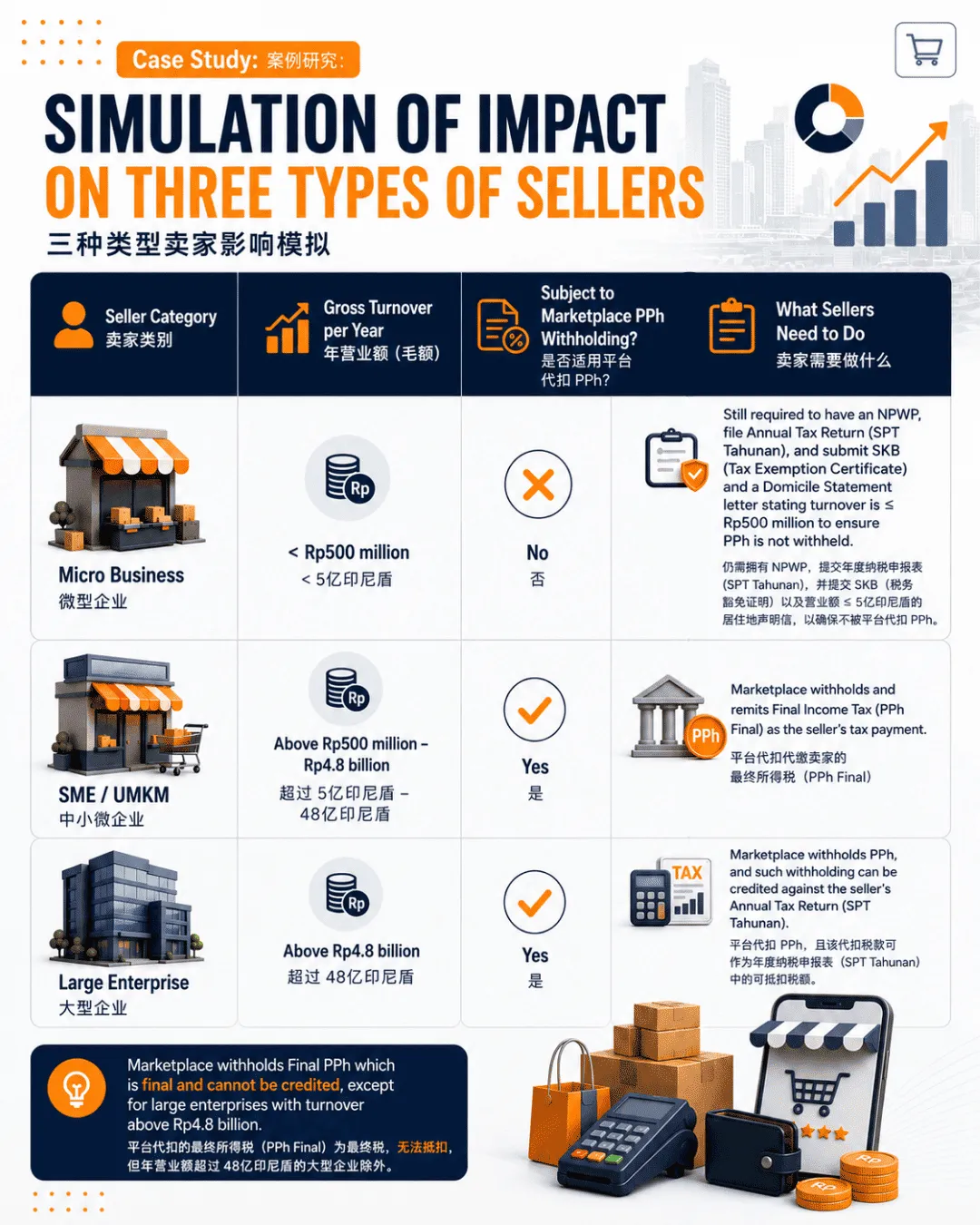
The IDR 10,000 deduction is not a new type of tax that makes you pay twice, but rather an installment or advance tax payment deducted directly by the marketplace at the time of transaction. Later at the end of the year, when the seller calculates their total tax liability in the Annual Tax Return (SPT), the IDR 10,000 that has been deducted through e-commerce throughout the year will be considered as a reduction of your tax debt balance.
One thing that must be watched out for: if you sell on more than one different platform (for example, on Tokopedia and Shopee simultaneously), the DJP will combine all turnover from all these platforms. The reference used is the total overall turnover of the individual or business entity, not the turnover of each store or marketplace separately.
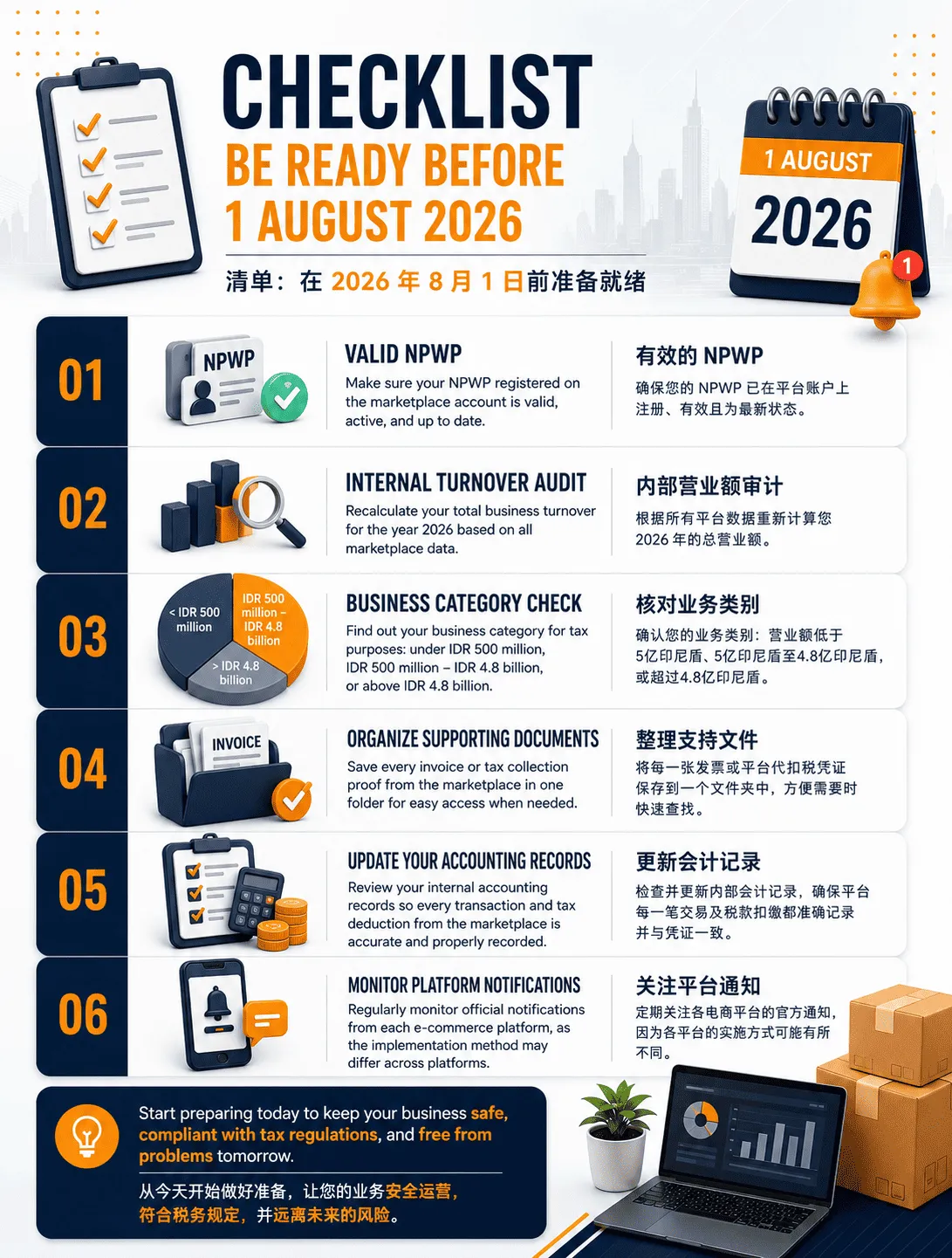
Readiness Checklist Before August 1, 2026
Don't wait until your store balance has problems in the system. Complete the following six self-check steps before the enforcement deadline begins:
FAQ: Questions About Marketplace PPh Rules
1. Do I need to re-register my NPWP to be subject to this deduction?
No, but ensure that the NPWP data uploaded to your marketplace account is correct, active, and synchronized with DJP data.
2. What happens if I sell on four different marketplaces?
Turnover from all platforms will be combined by the DJP in the final calculation of your annual SPT.
3. How do I check my PPh Article 22 withholding proof?
The withholding proof in the form of an official electronic invoice from the marketplace will be available and can be monitored directly in the Coretax system.
4. Is the 0.5% rate calculated from gross turnover including VAT?
No. The withholding rate is calculated purely from the gross circulation of goods sales, excluding VAT and luxury goods sales tax (PPnBM) components.
5. Can moving sales to social media avoid this tax?
No. Tax obligations on income remain legally attached, regardless of the sales channel or platform you use.
6. When exactly does the automatic deduction start?
Effective from August 1, 2026, after passing the transition period and system adjustment for one month since the official appointment on July 1, 2026.
7. What if my turnover is exactly at the critical threshold?
If your business turnover is around the nominal threshold (such as approaching IDR 500 million or IDR 4.8 billion), you should immediately consult with an expert team to receive the appropriate tax treatment according to standard regulations.
Align Your Online Store's Legality and Tax Compliance
The implementation of PMK Number 37 of 2025 is concrete evidence that the integration of digital financial data in Indonesia is no longer avoidable. The best step to protect the sustainability of your online business from the risk of financial disputes or administrative penalty fines is to build a solid legal compliance system from the start.
For medium-scale online store owners whose turnover continues to skyrocket past the IDR 4.8 billion threshold, your company's legal status must be upgraded so that your business rights are fully protected. Our consultant team at Awan Kusuma is ready to assist you in the official PKP (Taxable Entrepreneur) confirmation process, so that your business structure is legally recognized and ready to establish wider distribution partnerships with large corporations.
Additionally, so that this transition period of automatic tax deductions by e-commerce platforms does not disrupt your business financial balance at the end of the year, our expert team is also ready to help audit and organize your corporate Annual Tax Return (SPT) reporting documents. With professional management, every rupiah deducted by e-commerce will be accurately recorded as a valid tax reduction.
Don't let changes in the administrative system disrupt the cash flow stability of your online store. Contact Us via WhatsApp now for business tax legal consultation and the best business licensing solutions!