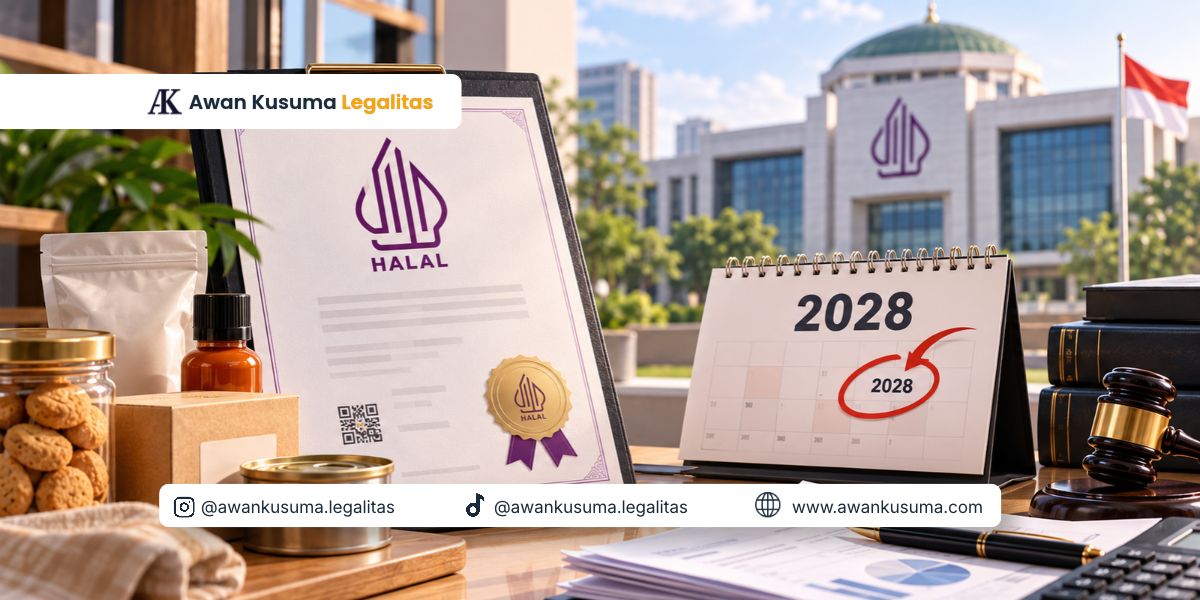
The government has extended the phased timeline for the mandatory halal certification requirement. According to a press release from the Coordinating Ministry for Economic Affairs (16 October 2026), the requirement for micro and small enterprises (MSEs) for food, beverage, slaughter products, and slaughtering services is extended until 17 October 2028. The requirement for food and beverage services (excluding slaughtering services) and imported products begins on 18 October 2028. This change is made through a Government Regulation amending PP 42/2024. The halal requirement is not removed, only its schedule is shifted.
Table of Contents
- What did the government announce?
- Summary of the new dates
- Which products are postponed, and which are not?
- Why the postponement?
- What does BPJPH say? Latest status
- How has the public responded?
- What exactly is required?
- Why is implementation not simple?
- What should businesses do now?
- FAQ
- Need help?
- Official sources
1. What did the government announce?
The Coordinating Ministry for Economic Affairs held a socialization session on the mandatory halal certification policy on 16 October 2026 for ministries/agencies, BPJPH, business and industry associations, and relevant stakeholders.
Under PP 42/2024, a number of mandatory halal certification requirements were actually scheduled to take effect on 18 October 2026. However, based on evaluation and input from business and industry associations, the government considered it necessary to adjust the phased timeline so that the ecosystem and all parties have room to prepare.
The Secretary of the Coordinating Ministry for Economic Affairs, Susiwijono Moegiarso, stated that the phased timeline is extended through a Government Regulation on the Amendment to PP 42/2024. The government reaffirmed that its commitment to Halal Product Assurance continues.
2. Summary of the new dates
- Services for food, beverages, and slaughter products (excluding slaughtering services): mandatory starting 18 October 2028 (amendment to Article 160).
- Micro and small business operators, for food, beverage, slaughter products, and slaughtering services: phased timeline extended until 17 October 2028.
- Food, beverage, slaughter products, and slaughtering services from abroad: mandatory starting 18 October 2028, taking into account mutual recognition cooperation for halal certificates (amendment to Article 160 paragraph 3).
- Natural medicines, quasi-medicines, health supplements, cosmetics, chemical products, genetically engineered products, and a number of consumer goods: phased timeline until 17 October 2028 (amendment to Article 161).
- Over-the-counter medicines and limited over-the-counter medicines: remain 17 October 2029.
- Hard medicines other than psychotropics: remain 17 October 2034.
3. Which products are postponed to 2028, and which are not?
Extended to 2028:
- Food, beverage, slaughter products, and slaughtering services belonging to MSEs.
- Food and beverage services, such as restaurants and catering (excluding slaughtering services).
- Imported food and beverage products.
- Natural medicines, quasi-medicines, health supplements, cosmetics, chemical products, genetically engineered products, and a number of consumer goods.
Unchanged from the PP 42/2024 schedule:
- Over-the-counter medicines and limited over-the-counter medicines (2029).
- Hard medicines other than psychotropics (2034).
The government also stated that it will adjust the implementing regulations of PP 42/2024 and revoke BPJPH Regulation Number 4 of 2026 on the assurance of conformity of foreign halal products entering Indonesia.
4. Why the postponement?
According to the official press release, the reasons include:
- The scope of the requirement is very broad and involves millions of business operators across various sectors.
- Input from business and industry associations.
- Readiness of the national halal ecosystem.
- Completion of mutual recognition cooperation for halal certificates for foreign products.
The government stated that this adjustment is expected to maintain consumer protection, provide certainty and room for adjustment for business operators, maintain smooth trade, and strengthen the competitiveness of the halal industry.
5. What does BPJPH say? Latest status
At the time this article was written (19 October 2026):
- The Coordinating Ministry for Economic Affairs press release has been issued, and BPJPH was present at the socialization session.
- On 10 October 2026, the Head of BPJPH stated that the mandatory halal requirement would still take effect from 18 October 2026 without delay, while preparing special provisions for certain conditions such as MSEs and raw material products and consumer goods.
- We have not found an official BPJPH announcement following the 16 October press release.
- The schedule change is made through a Government Regulation amending PP 42/2024, whose number and issuance date need to be monitored.
This means business operators should not stop their preparations. Wait for the BPJPH announcement and the issuance of the amending Government Regulation before making a final decision.
6. How has the public responded?
This policy has sparked widespread discussion on social media. According to a Grok search of posts on platform X, posts mentioning the word "halal" peaked at 2,764 posts on 14 October 2026.
This figure should be read with caution:
- Most of the spike came from the #ISEF2026 hashtag, which appears to be a coordinated campaign, so it is not a reflection of organic opinion.
- Organic conversation was dominated by complaints about the certification burden for small traders, namely the cost, time, and complexity of the process.
- Some netizens framed this policy as an effort by the state to seek revenue. This is a perception circulating in public. In the official press release, the reasons cited by the government are consumer protection, certainty for business operators, and strengthening the competitiveness of the halal industry.
This data comes from a Grok search of posts on platform X and only represents users of that platform, not the entire Indonesian public. AI-based search results may differ between search times and may not cover all posts, so this figure should be read as a general picture. These complaints from small business operators align with the reason for extending the timeline for MSEs, which according to the government was taken after evaluation and input from business associations.
7. What exactly is required?
The mandatory halal certification requirement originates from Law 33/2014 on Halal Product Assurance as amended by Law 6/2023, with implementing regulations including PP 42/2024.
One thing that is often misunderstood: this rule does not prohibit non-halal products from circulating in Indonesia. What is required is transparency: halal-certified products are given a halal label, and products that are not halal are given a non-halal indication. The goal is for consumers, including the majority Muslim population in Indonesia, to clearly know the status of a product.
8. Why is implementation not simple?
In practice, implementing mandatory halal requires coordination among several government agencies as rule enforcers. Certification, distribution supervision, supervision of imported products, and sanction enforcement involve different institutions. Therefore, business operators need to understand the flow and required documents from the outset, rather than waiting until close to the deadline.
9. What should businesses do now?
- Map your products and their category: food or beverage, cosmetics, supplements, raw materials, or services.
- Check your business category: MSE, medium enterprise, or importer. Each category has a different schedule.
- Start from ingredients and processes. The list of ingredients, suppliers, and production flow is the basis for certification.
- Sort out your business legality (NIB, distribution permits, and other documents) because these are usually requested during the application.
- Don't delay just because there is an extension. Certification queues usually pile up near the deadline.
- Monitor announcements from BPJPH and the Coordinating Ministry for Economic Affairs for the issuance of the amending Government Regulation.
10. Frequently asked questions (FAQ)
Is the mandatory halal requirement really postponed to 2028?
According to the official press release from the Coordinating Ministry for Economic Affairs dated 16 October 2026, the phased timeline for MSEs is extended until 17 October 2028, while food and beverage services (excluding slaughtering services) and imported products begin on 18 October 2028. The change is made through a Government Regulation amending PP 42/2024.
Are all products postponed to 2028?
No. Over-the-counter medicines and limited over-the-counter medicines remain 17 October 2029, and hard medicines other than psychotropics remain 17 October 2034.
What about MSEs?
The phased timeline for the requirement for micro and small business operators for food, beverage, slaughter products, and slaughtering services is extended until 17 October 2028.
What about imported products?
The mandatory halal certification requirement for food, beverage, slaughter products, and slaughtering services from abroad begins on 18 October 2028, taking into account mutual recognition cooperation for halal certificates.
Are non-halal products prohibited?
No. This rule requires clarity of halal or non-halal status on products, not a prohibition on their circulation.
Are restaurants and catering also postponed?
The requirement for services for food, beverages, and slaughter products (excluding slaughtering services) begins on 18 October 2028 in accordance with the amendment to Article 160.
Has BPJPH announced this postponement?
As of 19 October 2026, we have not found a BPJPH announcement following the 16 October press release. Monitor the official BPJPH website and the issuance of the amending Government Regulation.
Why do many small business operators complain about mandatory halal?
Conversation on social media is dominated by complaints about the certification burden for small traders, namely the cost, time, and complexity of the process. The government stated that the schedule adjustment was made after evaluation and input from business associations to provide room for preparation.
Is it better to postpone certification until 2028?
Not advisable. Certification requires preparation of ingredients, processes, and documents. Starting early avoids pile-ups near the deadline and strengthens consumer trust.
11. Need help preparing legality and halal certification?
Halal certification requires well-organized business legality documents, from the business entity form and NIB to other permits that accompany your product. Many small business operators find the process complicated. Awan Kusuma Legalitas helps organize legality and supporting documents so you are not overwhelmed when the deadline approaches.
📞 Contact Awan Kusuma Legalitas for a consultation.
Disclaimer: This article is informative in nature, not legal advice. Policies may change with the issuance of the amending Government Regulation and BPJPH announcements. Verify with official sources.